
The Place of Logic in the Farangī Maḥall & Khairābād
Through Mīr Fatḥullāh Shīrāzī, the scholars of the Farangī Maḥall became inheritors of the long-standing Islamic intellectual tradition—one that includes a constellation of towering figures such as Mullā Dawwānī, Mīr Sayyid Jurjānī, Imām Quṭb al-Dīn al-Rāzī, Imām Fakhr al-Dīn al-Rāzī, Imām Abū Ḥāmid al-Ghazālī, and Imām al-Ḥaramayn al-Juwaynī, among many others.
Within the rational sciences (al-maʿqūlāt), the scholars of the Farangī Maḥall pursued research of considerable depth, to the extent that they were later recognised for contributing original developments to these disciplines themselves.
A clear example of this may be seen in the science of logic (manṭiq). The Farangī Maḥallīs did not merely transmit the logic manuals as they had been received; rather, they expanded their scope and facilitated their widespread study through the Dars-i Niẓāmī curriculum, which became the principal vehicle for the transmission of the sacred sciences in the subcontinent and remains so to this day. They also devoted sustained attention to mixed logic (manṭiq mamzūj), advancing it further through the commentarial tradition and producing works marked by original and rigorous inquiry.
It is important to note, however, that such engagement with the rational sciences—and the incorporation of a significant number of their works into the Dars-i Niẓāmī by Mullā Niẓām al-Dīn al-Sihālawī—do not warrant the claim, often advanced in a loaded and anachronistic manner, that the Farangī Maḥall was a “rationalist” school.
The ultimate aim of the scholars of the Farangī Maḥall was the formation of individuals who had mastered the auxiliary sciences (al-ʿulūm al-āliyyah) to the degree necessary for sound engagement with the intended sciences (al-ʿulūm al-maqṣūdiyyah)—namely, the Holy Qurʾān and the Noble Sunnah. The inclusion of numerous works in Arabic language, for example, alongside a more limited number of texts directly concerned with tafsīr, was never indicative of a prioritisation of language over revelation (of the Holy Qurʾān). Rather, the former was always conceived as a means placed firmly in the service of the latter.
The rational sciences were also never studied in isolation, nor without an overarching framework. One of their central aims was to prepare scholars capable of articulating and defending Islamic creed with precision and clarity in intellectual settings that remain familiar to us even today.
Each discipline within the rational sciences served a defined function: logic trained the mind to define correctly and to avoid error in intellectual inquiry; falsafah was engaged insofar as it enabled the study of ʿilm al-kalām, equipping scholars to identify and refute philosophical positions that conflicted with Islamic doctrine; dialectics fulfilled its own specific objectives; and so on.
Much more could be said on this subject. However, what has been outlined here reflects the manhaj transmitted to us by scholars who directly benefited from the Farangī Maḥall tradition.
To see how this intellectual balance was realised pedagogically, explore our free orientation on the classical study of logic within the rational sciences, through Mīr Sayyid Jurjānī’s Ṣughrā and Kubrā, two foundational works within the Farangī Maḥall curriculum.
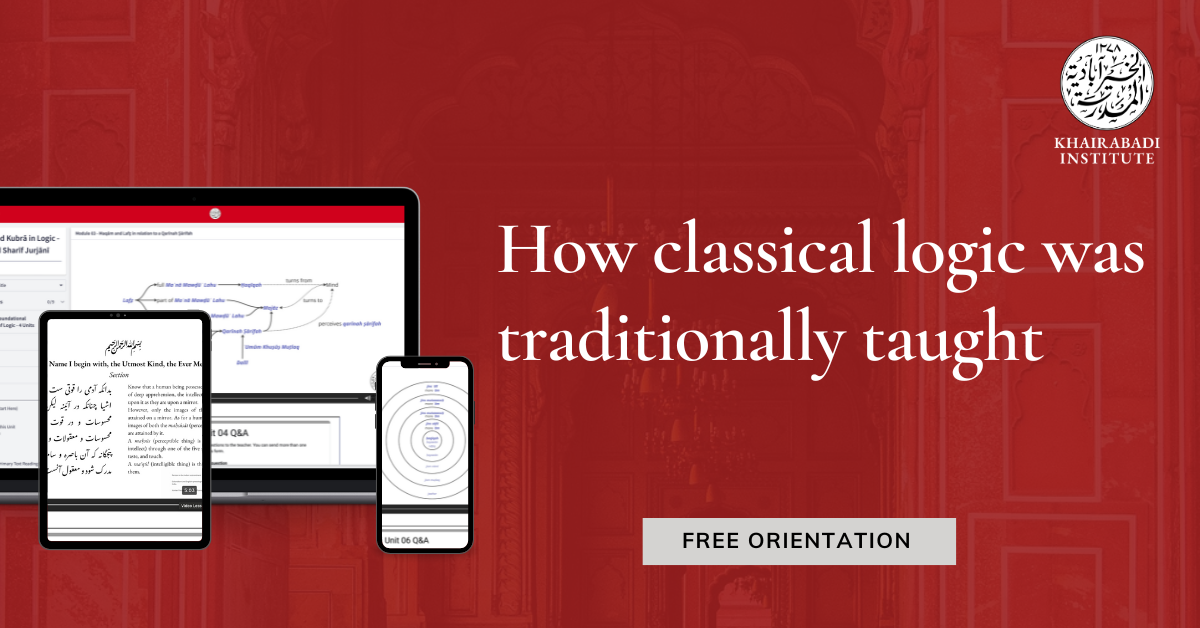
Access the Free Logic Orientation
A guided introduction to classical logic as taught in the Farangī Maḥall tradition.
