
Why Methods of Studying Arabic Differ
Why the Farangī Maḥall Tradition Remains Foundational
There are many methods for learning the Arabic language today, each designed to serve a particular objective. Some approaches aim primarily at spoken Modern Standard Arabic, while others are intended for the study of classical Arabic in order to access the Holy Qurʾān, the Noble Sunnah, and the auxiliary sciences preserved within the classical scholarly tradition.
Even within this latter objective, methods differ significantly. Some are better suited to native Arabic speakers, while others are designed for non-Arab students. Certain approaches provide only a basic entry into word- and sentence-structure, enabling limited access to classical texts under constraint.
Other methods, however, are constructed to give students full access to the world of classical Arabic, laying foundations that allow progression to advanced works such as Mullā Jāmī’s commentary on al-Kāfiyah, together with the ḥāshiyah of ʿAbd al-Ghafūr, Ḥāshiyah ʿalā Sharḥ al-Shāfiyyah of Mīr Sayyid Jurjānī, and al-Muṭawwal of Imām al-Taftāzānī.
It is within this latter pedagogical vision that the Arabic primers of the Farangī Maḥall occupy a central place, with Mīzān al-Ṣarf serving as the first formal text in the curriculum. Despite their unmatched pedagogical utility, these primers have gradually fallen out of circulation in recent times due to a number of historical and institutional factors.
We firmly maintain that the early primers of the Farangī Maḥall tradition, across multiple disciplines, play a decisive role in enabling novice students to grasp the sciences at the outset. Many of these works were authored by scholars who also composed the most advanced texts in the curriculum, and were deliberately written as bridges to the later tradition.
Their content allows students to understand each science on its own terms, presented in a codified form that—if expanded—mirrors the structure of an advanced text in the same field. It is for this reason that Mīr Sayyid’s Naḥw Mīr is often described as a concise counterpart to Sharḥ Mullā Jāmī ʿalā al-Kāfiyah.
In more recent times, due to factors such as the decline of the Persian language and broader shifts in educational approaches, these time-tested models are rarely adopted at the outset of study.
In their place, newer works have become widespread. While there is undoubtedly benefit in many of these publications, experience has shown that the older mutūn are often more comprehensive in nature.
They are concise yet contain the nuances that bring clarity to a subject; though often embedded within the text, these nuances require an instructor to unravel them. Their authors leave no necessary stone unturned, while deliberately excluding details a student does not yet need. The results produced by such works are not easily replicated by modern renditions.
At Khairabadi Institute, our mission is to bridge this gap by reintroducing these classical works to contemporary students, while also providing the tools needed to access them—addressing language barriers and other challenges that would otherwise prevent meaningful engagement with this tradition.
To stay informed about forthcoming developments related to this initiative, scheduled to be shared later this week, in shāʾ Allāh, readers may add their name to the form below.
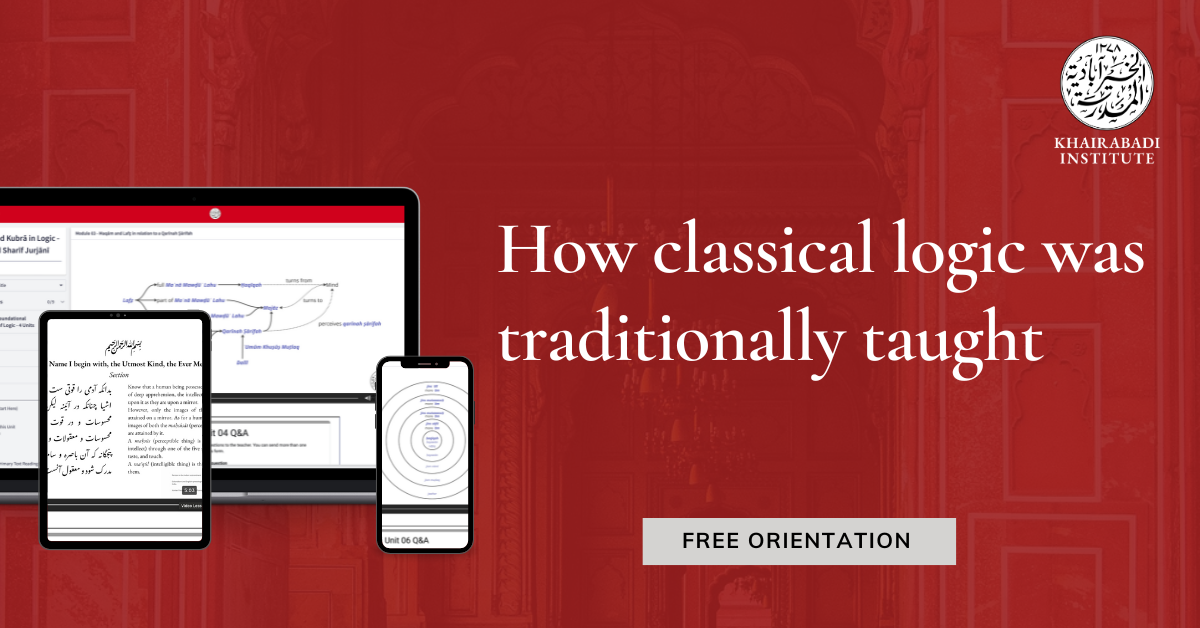
Access the Free Logic Orientation
A guided introduction to classical logic as taught in the Farangī Maḥall tradition.
