
A Household Name for Six Centuries
Mīzān al-Ṣarf is one of the most important and foundational texts in ʿilm al-ṣarf (the science of Arabic morphology). Authored approximately six centuries ago, its study became so widespread in this time that it came to hold the status of a household name, to the point that we even find its mention in the genre of poetry.
Throughout this approximate six century period, it has been taught continuously in many madāris and centres of learning, particularly in the ʿajamī lands of the east, including the Indian subcontinent and possibly extending into other regions aswell. Its pedagogical position became such that it held the rank of the opening gateway among the Arabic texts. No beginner in classical Arabic commenced without it, and no advanced student was free of need from it.
The Opening Gateway in the Classical Dars-i Niẓāmī
In the tradition of the Farangī Maḥall, Mullā Niẓām al-Dīn al-Sihālwī specifically chose this text to be the very first work taught in the Dars-i Niẓāmī curriculum to students in the science of Arabic, specifically morphology. This was traditionally followed by Munsha'ib, Panj Ganj, Zubdah, Ṣarf Mīr, Fuṣūl-i Akbarī, and al-Shāfiyah.
Structure and Design
The text is approximately twenty one pages. It lays down the foundations of Arabic morphology at the first stage of study, presenting the subject as a coherent system without overwhelming the student with conjugation tables. The structure is deliberate and student friendly. Nothing is presented out of context; each section opens naturally into the next, and what precedes always connects to what follows. The ordering itself is instructional. The text also belongs to the classical compositional tradition, meaning that students who progress to more advanced works in the same science will find the register and structure familiar rather than foreign.
Why Classical Texts Endure
There are a number of benefits to engaging with classical texts.
Texts that have been transmitted over centuries, from one generation of scholars to the next consecutively, undergo great levels of refinement. Many of these refinements get highlighted either from chest to chest, or in the vast corpus of commentaries and super commentaries that accompany these publications. The benefit of these commentaries is not only that the text is given further clarity, but due to the time periods involved, those commentators end up being major scholars whose commentaries prove to be gems as well.
Furthermore, earlier works were written by masters of the subject, scholars whose works were accepted to such a degree that other scholars, fully capable of writing similar texts, sufficed with these works for their own syllabi. Take in this case Mīzān al-Ṣarf; Mullā Niẓām al-Dīn did not write his own work on ṣarf; he sufficed with this text for his own students.
The utility of professional writing at this calibre is that nothing gets added at a stage which a student does not need to know, and nothing is left out that a student needs at that stage. This is essentially a type of ijtihād (literally speaking) based on great amounts of knowledge and experience: how a work should be laid out, what comes first, what follows on from it, what should be introduced now but elaborated on later, and if something is introduced, what choice of wording should be presented so that it does not confuse the student. All of these kinds of taḥqīqāt and ijtihādāt, while maintaining rabṭ (connection) with what comes before and after, prove a heavy task. Relying then on works that sufficed earlier celebrated scholars allows one to feel content that he is in good hands.
Take, for example, the opening section of Mīzān al-Ṣarf, which is just one single paragraph. The author is able to begin with one maqsim (a single subject of division) and, using the procedure of iḥtimāl ʿaqlī (rational possibility), divide and subdivide until, by the end of that one paragraph, he has not only introduced major components of ṣarf all brought together, but he also leaves the student with eight verb sets that naturally follow and are very clear and understandable.
Of course, those eight sets are not given straight away, but the groundwork is done to introduce them. It goes without saying that just explaining what the author of Mīzān has done in a single paragraph could easily cover eight to ten chapters of modern renditions of ṣarf works. The beauty here is that a student could memorise that matn as well, so that this ʿilm remains mustaḥḍar (readily present in the mind) to be accessed whenever needed.
Another benefit, which was touched upon earlier, is the commentarial literature that comes with earlier texts. Earlier texts have attracted great commentators who help instructors and walk them through the text in such a way that it becomes very difficult for modern teachers to go off track, make innocent errors, or fail to understand nuances. This is not to say that modern teachers are necessarily incapable of achieving this themselves, but in the case of Mīzān al-Ṣarf, it attracted many commentaries, such as that of ʿAllāmah ʿAbd al-Ḥayy al-Lakhnawī. Holding the hand of a giant like him while taking students on a journey proves a utility that cannot easily be expressed in words. Those who teach will understand the importance of such support, especially in the later echelons of the curriculum.
Moreover, many of the classical texts were written by saintly scholars. Their works are taught and available today because of the barakah placed within them. There is a reason why studying Naḥw Mīr gives you Arabic in a way many other texts cannot. We know, for example, that during the entire period of writing al-Hidāyah in Ḥanafī fiqh, ʿAllāmah al-Marghīnānī fasted in such a way that neither his servant nor his students were aware of his supererogatory fasting.
Famous Text, Disputed Authorship
As famous as this text is, the question of its authorship has attracted considerable discussion. While the majority of scholars attribute it to a single author, the authorship of Mīzān al-Ṣarf has in total been attributed to eight individuals:
Shaykh Sharaf al-Dīn ibn ʿAbdillāh Saʿdī Shīrāzī (d. 691 AH)
Shaykh Sirāj al-Dīn ʿUthmān Awadhī, known as Akhī Sirāj (d. 758 AH)
Shaykh Wajh al-Dīn ibn ʿUthmān ibn Ḥusayn
Shaykh Ṣafī al-Dīn ibn Naṣīr al-Dīn ibn Niẓām al-Dīn Radawlawī (d. 819 AH)
Mullā Muḥammad Dānish
Mawlānā Muḥammad ibn Muṣṭafā ibn al-Ḥājj Ḥasan (d. 911 AH)
Mullā Ḥamzah Badāyūnī
Sayyid ʿUthmān, known as Lāl Shahbāz Qalandar (d. 673 AH)
The Majority Position and Recent Research
The majority of the ʿulamāʾ and historians hold the view that the author of Mīzān al-Ṣarf is Shaykh Sirāj al-Dīn ʿUthmān Awadhī (raḥimahullāh). He was from among the scholars and ʿārifīn (gnostics) of eighth century Hijrī South Asia. He was a student of ʿAllāmah Fakhr al-Dīn Zarrādī. Both were disciples of Shaykh Niẓām al-Dīn Awliyāʾ, who in turn was the disciple of Shaykh Farīd al-Dīn, who was the disciple of Shaykh Bakhtiyār Kākī, who was the disciple of Khwājah Muʿīn al-Dīn Ajmerī Chishtī.
Interestingly, ʿAllāmah Fakhr al-Dīn actually wrote a text in ṣarf for his student Akhī Sirāj, known as Taṣrīf ʿUthmānī. Perhaps this is the same text as the one classically taught in seminaries known simply as Zarrādī. The text Zarrādī also holds a unique position from among the ṣarf genre, attracting multiple commentaries. Notable among them is Murādī Sharḥ Zarrādī by ʿAllāmah Shāʾistah Gul, the noble father of Shaykh Faḍl al-Subḥān al-Qādirī Khairābādī.
To this end, one author notes:
"Qawl-i rājiḥ ke aksar ulamā o muʾarrikhān ān rā taʾyīd namūdah and, īn ast ke muʾallif-i ān Shaykh Sirāj al-Dīn ʿUthmān Awadhī raḥmatullāhi ʿalayhi."
"The preferred opinion, which the majority of ʿulamāʾ and historians have endorsed, is that its (Mīzān al-Ṣarf) author is Shaykh Sirāj al-Dīn ʿUthmān Awadhī (raḥimahullāh)."
However, going against the position of the jumhūr, there is a contemporary research scholar by the name of ʿAllāmah Sājid ʿAlī Miṣbāḥī who has presented extensive, academic, and well researched evidence attributing Mīzān al-Ṣarf to Muḥammad ibn Muṣṭafā ibn al-Ḥājj Ḥasan (d. 911 AH). Among his findings, he writes that Ḥājī Khalīfah attributed Mīzān al-Ṣarf to Muḥammad ibn Muṣṭafā in his Kashf al-Ẓunūn, and that ʿAllāmah ʿAbd al-Ḥayy al-Laknawī did so as well in his al-Fawāʾid al-Bahiyyah. Similarly, this attribution has also been recorded in the book Ḥadāʾiq-i Ḥanafiyyah. And Allah Almighty knows best.
Shaykh ʿAbd al-Khabīr Ashrafī, summarising the various positions on authorship, concludes that Hidāyat al-Naḥw is without dispute the work of Akhī Sirāj al-Dīn ʿUthmān (raḥimahullāh). No one has put forward any other name for its authorship.
As for Panj Ganj (a famous text taught in the Farangī Maḥall for ṣarf, known as the Five Treasures) and Mīzān al-Ṣarf, there is disagreement among the researchers. The majority hold these to also be his works, while ʿAllāmah Sājid ʿAlī Miṣbāḥī's research is that Mīzān al-Ṣarf specifically belongs to ʿAllāmah Muḥammad ibn Muṣṭafā ibn al-Ḥājj Ḥasan (raḥimahullāh).
In my humble opinion, while his research is extensive, it is not yet decisive enough, and the matter continues to warrant further taḥqīq and tanqīḥ, and access to manuscripts the world over, with more minds applying themselves to it. And Allah Almighty and His Rasūl ʿalayhi al-ṣalātu wa al-salām know best.
Reconnecting with the Tradition & Revival
Now, there are a number of reasons why these classical primers have gone out of circulation in modern times, and much could be said about those reasons and causes. But where some of those reasons pose a challenge to us today, we have endeavoured to address them, whether they are language barriers, the need for additional tamrīnāt and exercises, or other considerations. This is so that we can reconnect with an unbroken silsilah that is tried and tested over centuries to provide the best results, so that teachers can achieve what they set out to deliver and students can achieve what they set out to gain.
Alhamdulillāh, our students are beginning their official study of Mīzān al-Ṣarf this week as part of our One Year Classical Arabic Programme, covering al-Muqaddimah, Mīzān al-Ṣarf, Munsha'ib, and Naḥw Mīr. It is a great honour for us to be part of the revival of these great classical texts, and we are thrilled for students in the West to gain first hand insight and experience of their utility and benefit in achieving the goal of learning classical Arabic.
We ask Allah Almighty that He rewards the author of Mīzān al-Ṣarf, and that He makes his Mīzān heavy in good deeds on the Day of Judgement. Āmīn.
If you would like a free preview of our classical Arabic programme, click here.
Bibliography
Āʾīna-i Hindustān, Akhī Sirāj al-Dīn ʿUthmān
Maqāla Dars-i Niẓāmī kī Ahammiyyat
Mīzān al-Ṣarf
Muqaddimah Mīzān al-Ṣarf, Jāmiʿa Ashrafiyyah
Akhbār al-Akhyār
Fayżān-i ʿUthmān Marwandī
Murādī, Sharḥ Zarrādī
Al-Tibyān
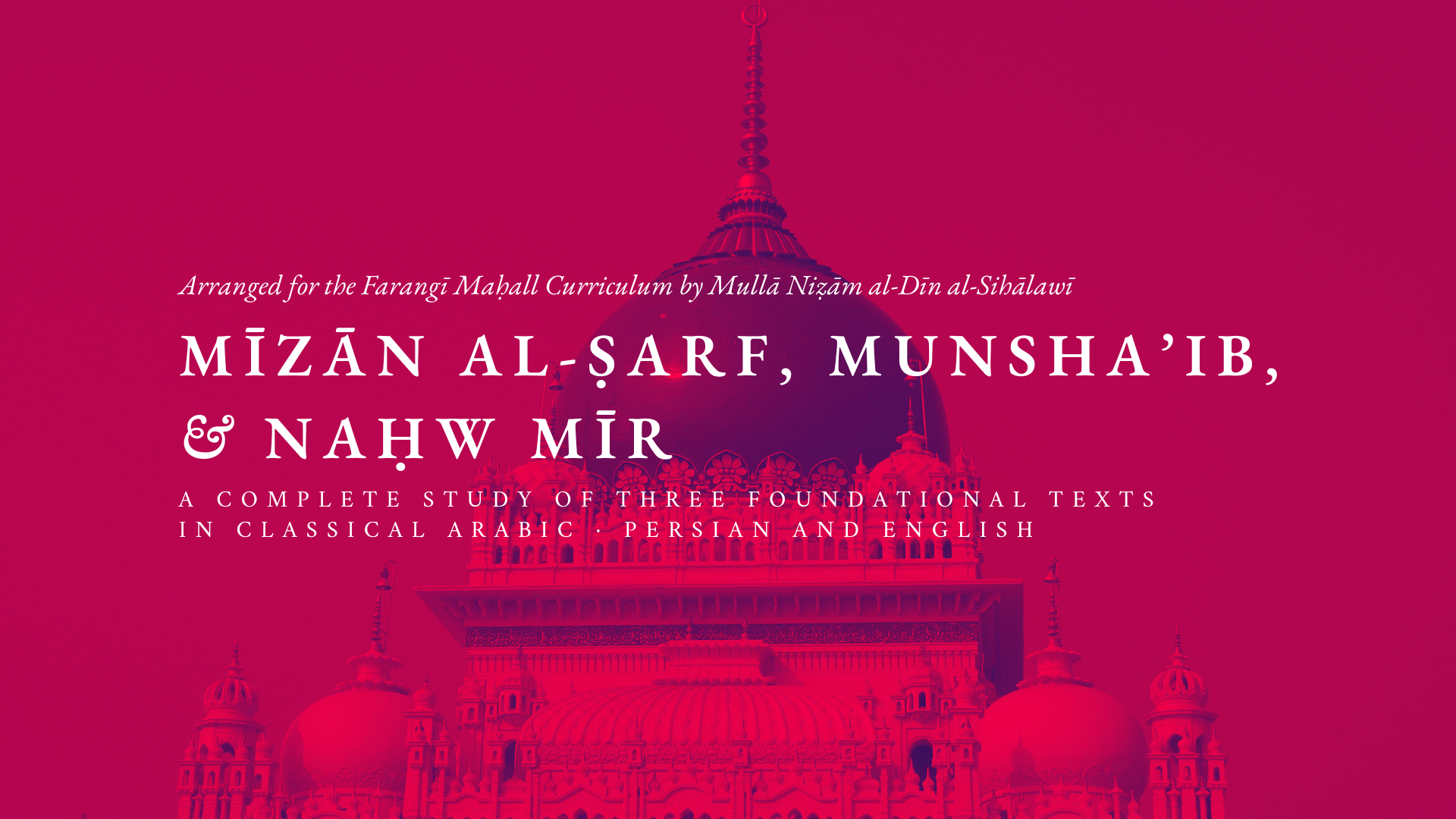
The opening works of the original Dars-i Niẓāmī Arabic curriculum have proven over centuries to be among the most effective pathways into classical Arabic, offering precision and clarity while remaining concise.
Taught through the Khairābādī pedagogical framework, with rare scholarly elucidations of ʿAllāmah ʿAbd al-Ḥayy al-Lakhnavī al-Farangī Maḥallī presented throughout.
