

Arranged for the Farangī Maḥall Curriculum by Mullā Niẓām al-Dīn al-Sihālawī
MĪZĀN AL-ṢARF · MUNSHA'IB ·
NAḤW MĪR
A COMPLETE STUDY OF THREE FOUNDATIONAL TEXTS IN CLASSICAL ARABIC · PERSIAN AND ENGLISH

Course Overview - Relying on the Classics
Three Paths into Arabic - Which One do I choose?
Not all paths into Arabic lead to the same place. Some are designed for spoken communication. Others offer partial access to the written tradition. A third kind is built to carry students all the way into the classical scholarly library, to works such as Sharḥ Mullā Jāmī ʿalā al-Kāfiyah, al-Shāfiyah, and al-Muṭawwal. The Arabic primers of the Farangī Maḥall belong to this third path.
A Curriculum, Not a Collection
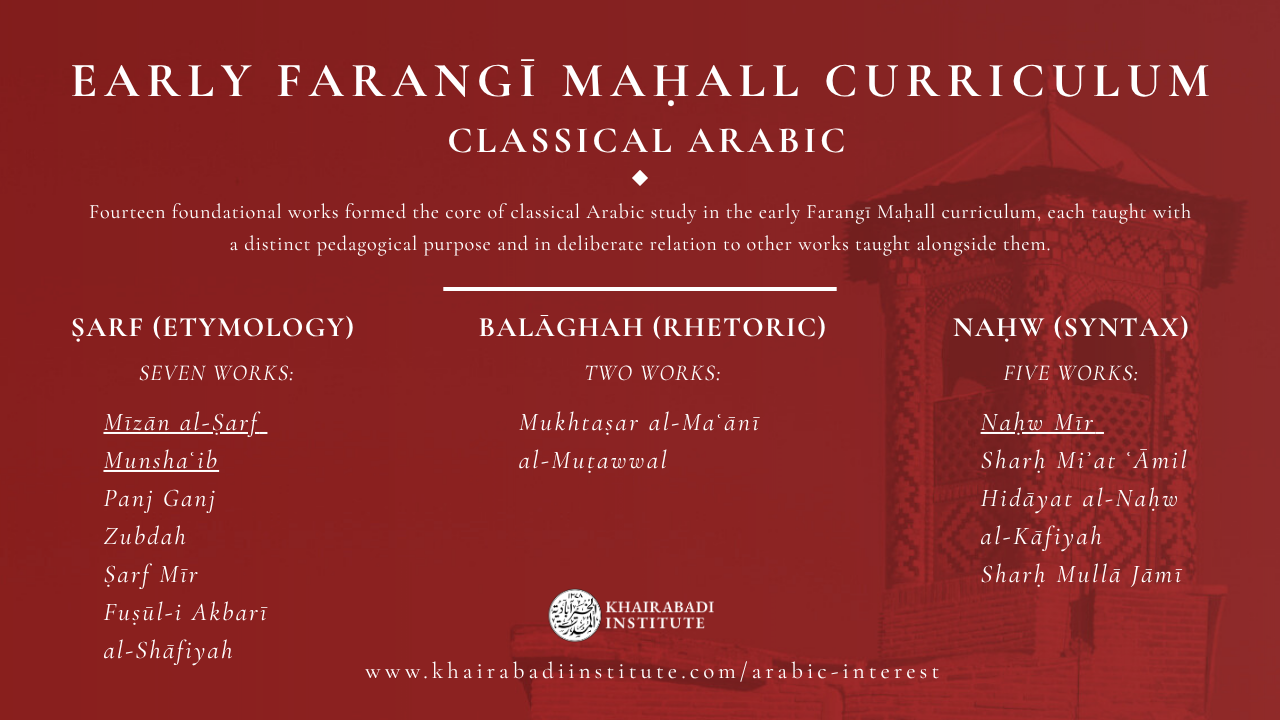
Mullā Niẓām al-Dīn al-Sihālawī arranged fourteen works across ṣarf, naḥw, and balāghah for the Farangī Maḥall curriculum. Each was chosen deliberately, each was interconnected, and each fulfilled a distinct function in the student's intellectual formation. This was not a loose collection of books, it was a carefully structured pathway in which no point of grammar was left obscure, reading classical texts became a matter of trained precision, and access opened progressively to every science, and ultimately to the Holy Qurʾān and the Noble Sunnah.
Two Common Situations
We have seen many students struggle with Arabic, eventually setting it aside and proceeding to the Islamic sciences without it. The difficulty does not disappear, it follows them into every text they study. We have also seen students who know Arabic well, yet carry fundamental gaps in their understanding of the language that lead to a lack of precision in their studies.
This programme addresses both situations.
What This Programme Offers
It establishes a foundation designed to last, taught through the late-classical pedagogical approach of the Farangī Maḥall, proven over centuries to be among the most effective means of building malakah (intellectual proficiency) and genuine access to the tradition.
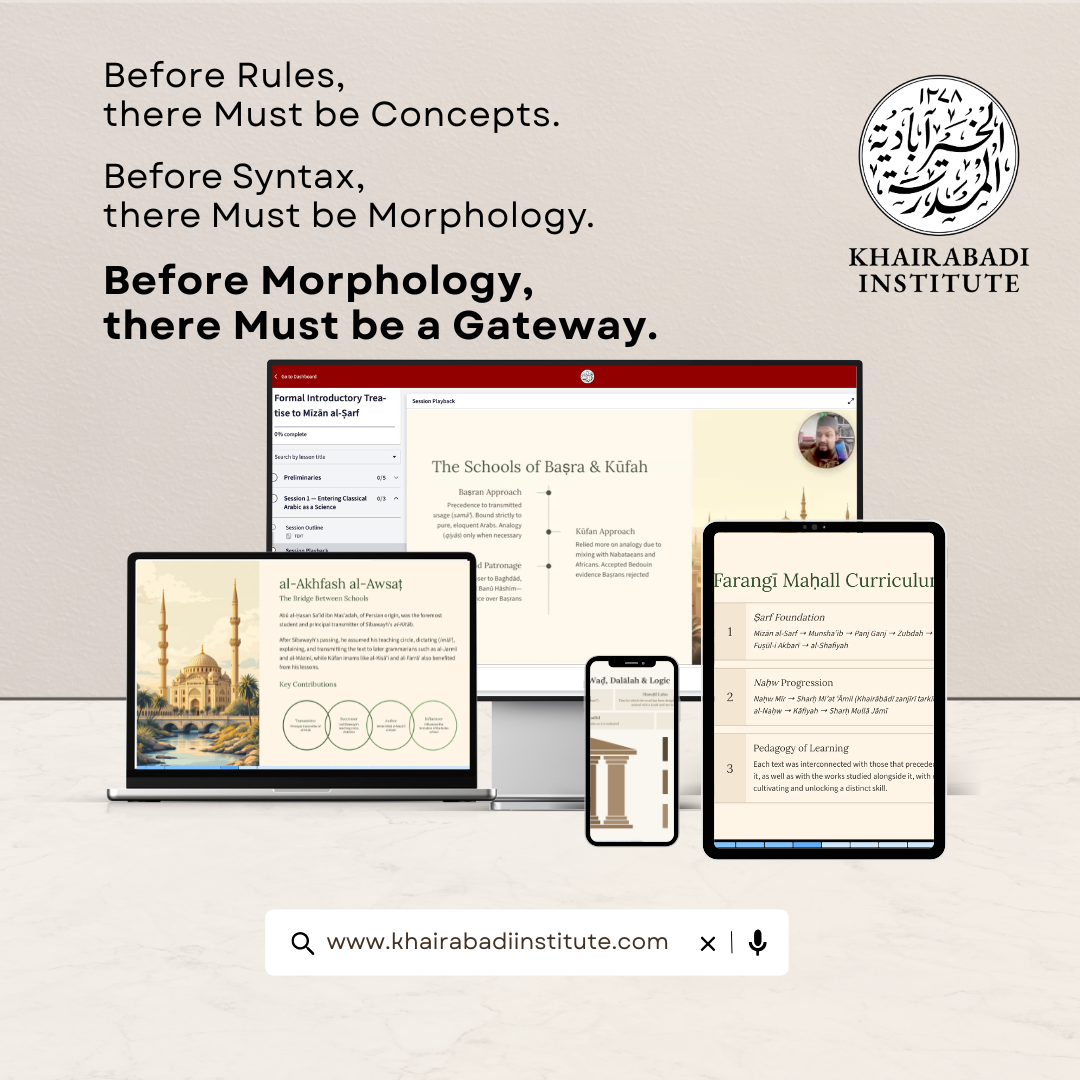
Beginning with Mīzān al-Ṣarf and its formal introductory treatise, progressing through Munsha'ib, and concluding with Naḥw Mīr of Mīr Sayyid Jurjānī; these are the first three works in the Farangī Maḥall curriculum for ṣarf and naḥw, taught in sequence as they were designed to be studied.
Students completing this year will have made a meaningful start in reading classical Arabic texts without tashkīl (Vowels), and will be prepared to advance to the next works in the curriculum, including the application of tarkīb zanjīrī in the Khairābādī tradition: a method passed down over generations in which every point of ṣarf and naḥw of each word within a sentence is examined before its syntactic position is established.
Style of Study
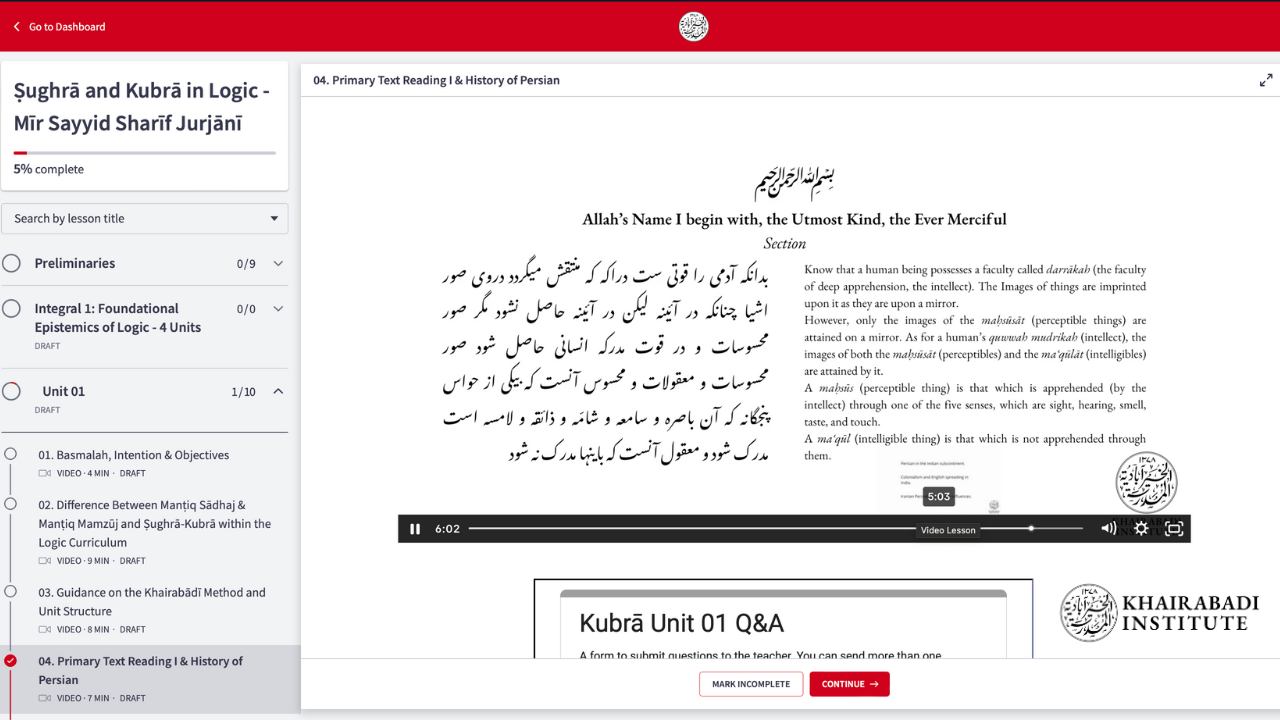
The programme is taught in accordance with the Khairābādī pedagogical method.
The instructor delivers a Khairābādī-style lecture, opening the meanings of the text and clarifying the objectives of the author. This lecture is then fitted back into the text completely. Students are subsequently required to memorise the lecture and demonstrate their ability to apply its insights back into the text themselves. In the tutorial sessions, students are also expected to recite by memory the modules studied.
-
Memorisation of conjugation tables and other foundational prerequisites is integral to the programme throughout. To support students in this, dedicated memorisation software, practice exercises, and question banks are included within each unit.
During the programme, rare ifādāt (scholarly elucidations) of Abū al-Ḥasanāt ʿAbd al-Ḥayy al-Lakhnawī al-Farangī Maḥallī on the Arabic sciences are presented, giving students a deeper grounding in each text and its place within the tradition.


A WORD FROM OUR PEERS
“Mawlānā Mubashir is inspired and aspiring… a person of high aspiration for serving tradition and embodying its high meanings."
— Shaykh Mustafa Styer
Course Outline
-
▸ UNIT 1: Entering Classical Arabic as a Science and the Foundations of Expression
▸ UNIT 2: The Measure in Morphology and Completing the Morphological Map -
▸ UNIT 3: The Khuṭbah and the Past Tense Verb I
▸ UNIT 4: The Past Tense Verb II
▸ UNIT 5: The Imperfect Tense Verb (Muḍāriʿ)
▸ UNIT 6: The Subjunctive Mood and the Jussive Mood
▸ UNIT 7: The Lām of Emphasis with the Nūn of Emphasis
▸ UNIT 8: The Imperative Verb (Fiʿl al-Amr)
▸ UNIT 9: The Prohibitive Verb (Fiʿl al-Nahy)
▸ UNIT 10: Derived Nouns I: Active Participle, Qualitative Adjective, and Passive Participle
▸ UNIT 11: Derived Nouns II: Noun of Place and Time, Noun of Instrument, Elative Adjective, and Verb of AstonishmentIfādāt (Scholarly Elucidations) of Abū al-Ḥasanāt ʿAbd al-Ḥayy al-Lakhnavī al-Farangī Maḥallī are presented throughout the units of this Integral.
-
▸ UNIT 12: Background, Khuṭbah, and the Bare Triliteral Verb (Thulāthī Mujarrad)
▸ UNIT 13: The Augmented Triliteral Verb (Thulāthī Mazīd Fīh)
▸ UNIT 14: Ilḥāq, Rubāʿī, and Full Consolidation -
Opening Principles (1 Unit)
▸ UNIT 15: Khuṭbah, Muqaddimah, and the Foundations of SpeechOn Iʿrāb and Binā' (4 Units)
▸ UNIT 16: Words of a Sentence and the Declinability of Words
▸ UNIT 17: Categories of the Unstable Noun: Definiteness and Gender
▸ UNIT 18: Number
▸ UNIT 19: The Sixteen Categories of the Stable Noun and the Iʿrāb of the MuḍāriʿBāb Awwal: Dar Ḥurūf ʿĀmilah (On the Operative Particles) (1 Unit)
▸ UNIT 20: On the Syntactic Operators (ʿAwāmil) and the Operative Particles (Ḥurūf ʿĀmilah)Bāb Dawm: Dar ʿAmal-i Afʿāl (On Verbal Governance) (2 Units)
▸ UNIT 21: Verbal Governance I
▸ UNIT 22: Verbal Governance IIBāb Siwm: Dar ʿAmal-i Asmāʾ-i ʿĀmilah (On Nominal Governance) (2 Units)
▸ UNIT 23: Nominal Governance (Qism 1)
▸ UNIT 24: Abstract Operators (Qism 2)Khātimah: Dar Fawāʾid Mutafarriqah (On Miscellaneous Principles) (1 Unit)
▸ UNIT 25: On the Syntactic Dependents, the Diptote, and the Non-Governing Particles -
▸ UNIT 26: Addendum, Tarkīb Zanjīrī in the Khairābādī Tradition, and Reading Classical Texts Without Tashkīlāt (Vowels)
How will the course be delivered?
The programme is divided into five Integrals, each broken down into units. Each unit contains pre-recorded modules, study resources, a question submission form and bank, memorisation software, exercises, and a live fortnightly tutorial on Zoom.
Modules are focused on a specific concept and include the instructor's taqrīr, a diagrammatic summary, and both the original text and English translation.
Students have two weeks per unit to complete their study, work through exercises, and consolidate their memorisation of any conjugational tables or exercises before attending the live seminar-style tutorial. These sessions are an opportunity for students to recite to the instructor, receive individual feedback, and benefit from related discussions beyond the core text.
Students have consistent access to the instructor throughout the programme.
Reflections from Our Students
"Mawlānā Mubashir sets himself apart from others by providing well-structured, clear, and easy to understand durūs for his students. He is able to take a book designed for beginners and provide a degree of depth and nuance that brings the listener to a level of understanding that can begin to appreciate higher-level discussions in the subject."
— Ibn Ibrāhīm
“I studied Dars-i Niẓāmī with Ustādh Mubashir and concepts were explained to us clearly and engagingly, making them accessible to even to beginners. Additional notes and resources were provided, to help not only grasp the basics but also delve deeper into the subject.”
— Umm al-Khair
About the Texts
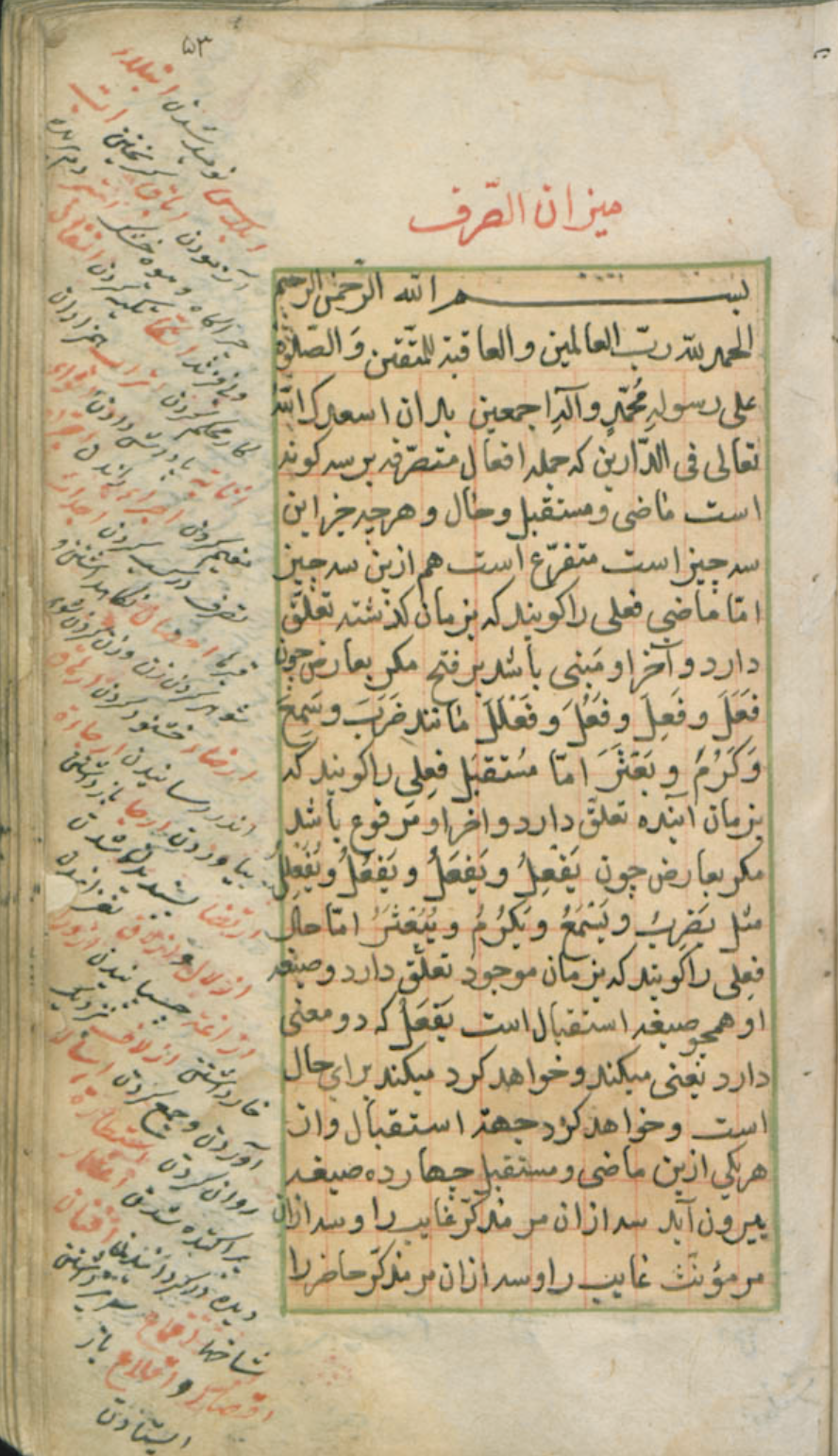
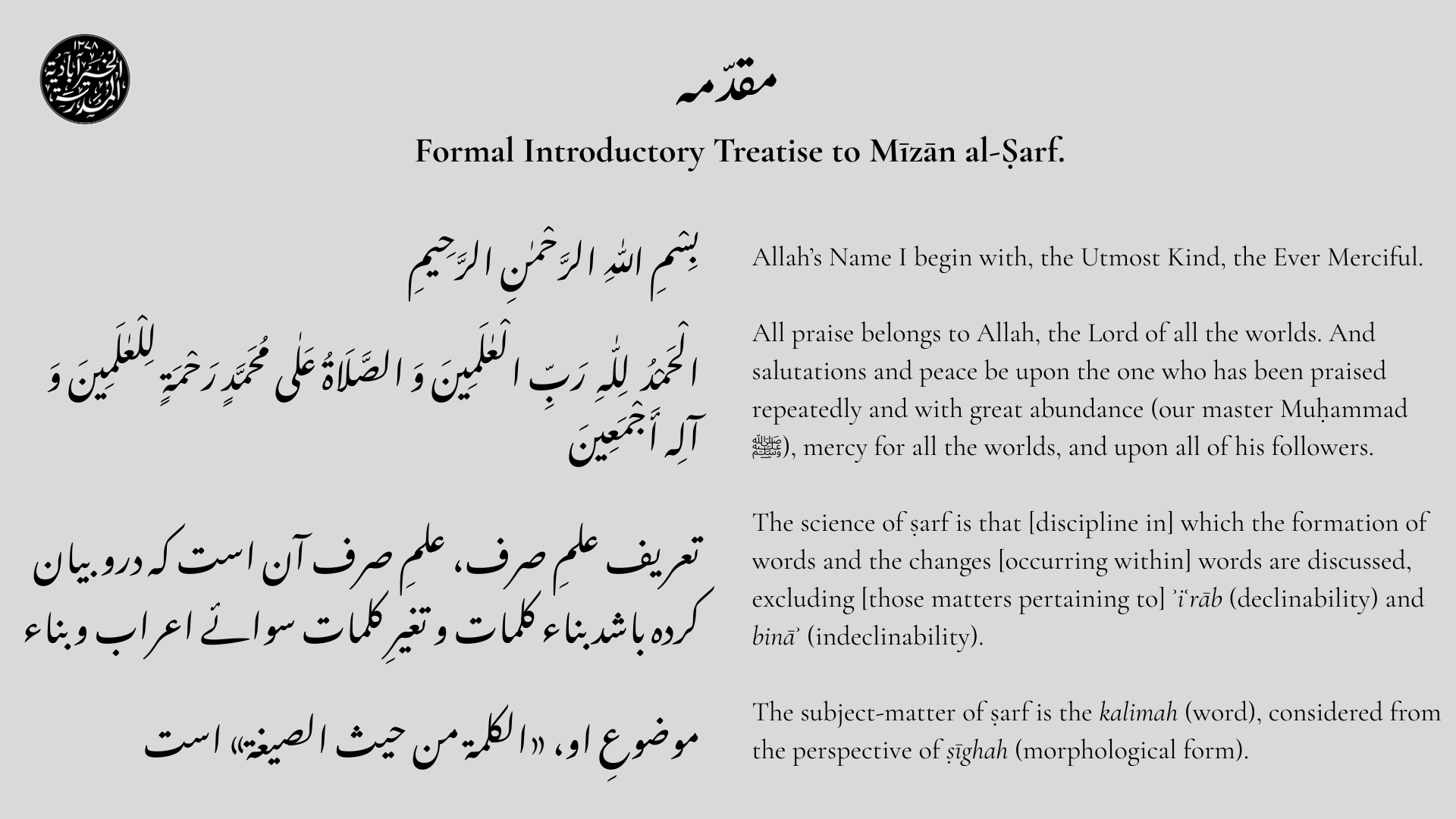
The Formal Introductory Treatise to Mīzān al-Ṣarf
A pedagogical treatise transmitted with Mīzān al-Ṣarf that establishes the core conceptual framework of Arabic morphology before formal study begins. It introduces students to Arabic as a codified science, covering the classification of expressions, the morphological scale (mīzān), root structures, and the seven morphological classes.
Mīzān al-Ṣarf
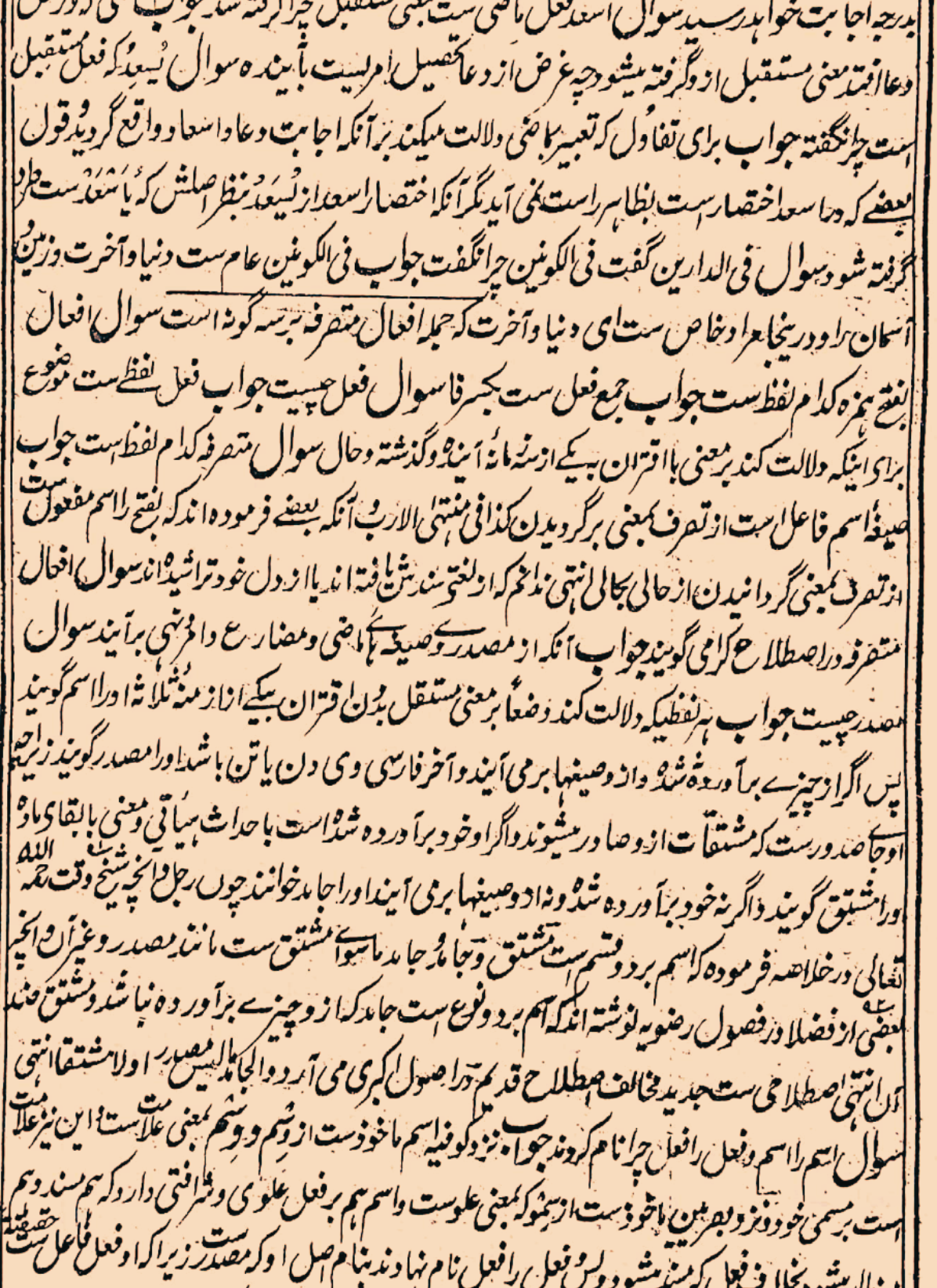
The first formal text chosen by Mullā Niẓām al-Dīn al-Sihālawī for entry into classical Arabic within the Farangī Maḥall curriculum. Spanning approximately twenty-one pages, it lays down the foundations of Arabic morphology at the first stage of study, presenting the subject as a coherent system without overwhelming the student with conjugation tables.
Munsha'ib
The second formal text chosen by Mullā Niẓām al-Dīn al-Sihālawī for entry into classical Arabic within the Farangī Maḥall curriculum. Spanning approximately eleven pages, it serves as a companion to Mīzān al-Ṣarf, introducing new discussions on the subject and forming a second layer of study after the initial foundation has been established. This reflects a pedagogical mastery that advances the student gradually (tadarrujan) through the science, without subjecting them to years of study within a single work.
Naḥw Mīr (Mīr Sayyid Jurjānī)
The foundational text in naḥw within the Farangī Maḥall curriculum, Naḥw Mīr is often described as a concise counterpart to Sharḥ Mullā Jāmī ʿalā al-Kāfiyah. It presents a systematic study of Arabic syntax and serves as an instructional manual that enables students to navigate more advanced works in due course.
-
Though the treatise appears to have been appended to Mīzān al-Ṣarf at a later stage, it remains one of the most thorough gateways into the Arabic sciences preserved within the late-classical tradition.
-
The structure is deliberate and student-friendly. Nothing is presented out of context; each section opens naturally into the next, and what precedes always connects to what follows. The ordering itself is instructional. The text also falls within the classical compositional tradition, meaning that students who progress to more advanced works in the same science will find the register and structure familiar rather than foreign.
It covers the full range of verbal forms, past, imperfect, imperative, and prohibitive, as well as the derived nouns, through a concise presentation that has proven its pedagogical value across generations of scholars.
On the question of authorship: the majority of scholars and historians attribute the text to Shaykh Sirāj al-Dīn ibn ʿUthmān, known as Akhī Sirāj. However, recent research from some muḥaqqiqīn presents strong evidence that the author is in fact Shaykh Muḥammad ibn Muṣṭafā ibn al-Ḥājj Ḥasan, a position supported by ʿAllāmah ʿAbd al-Ḥayy al-Lakhnawī and Ḥājī Khalīfah.
-
It maps the full classification of Arabic verb classes, covering the bare triliteral (thulāthī mujarrad), the augmented triliteral (thulāthī mazīd fīh), ilḥāq, and the quadriliteral (rubāʿī), providing students with the morphological map needed to situate Arabic verbs within the wider system of the language.
The author of this work is Mullā Ḥamzah Badāyūnī.
-
It commences with the definition and types of Arabic utterance, proceeds through a thorough treatment of iʿrāb and binā', culminates in a precise account of the syntactic operators (ʿawāmil), both explicit and abstract, and concludes with a number of miscellaneous benefits.
Its author, Mīr Sayyid Sharīf al-Jurjānī, is the same scholar who composed several curricular works taught within the classical Dars-i Niẓāmī, works that shaped the curricula of the Ottoman madrasas, al-Azhar, the Farangī Maḥall, and the Khairābādī tradition.
Note: All three works are originally in Persian. English translations will be provided to students for each text throughout the programme.
Reflections from Our Students
"Al hamdu lillah, session 1 (Arabic) exceeded my expectations. The historical background to the development of the disciplines of Arabic grammar and morphology was thorough and informative... it was obvious that the instructor is both passionate and knowledgeable about the subject, and he was very open to engaging with students' questions."
— Donnel
“I feel immensely blessed to have been granted this opportunity…
There is something profoundly transformative about studying a text authored by scholars deeply immersed in the classical tradition and who have written detailed commentaries on foundational works. Such authors do not merely teach grammatical rules; they transmit a living intellectual heritage.”
— Khan
Who is this course for?
Complete beginners to Arabic who want to enter the science through a well-grounded gateway.
Students who have studied Arabic but feel their foundations are incomplete or that key conceptual gaps remain.
Those who have studied modern Arabic methods and wish to enter the classical tradition properly.
Students who intend to access advanced works such as Sharḥ Mullā Jāmī ʿalā al-Kāfiyah, al-Shāfiyah, or al-Muṭawwal.
Those who are already studying the Islamic sciences and wish to build a firm Arabic foundation that their further study requires.
Serious students who want Arabic taught as the classical tradition intended, as a structured science with defined gateways, not a language to be memorised through scattered rules.
No prior knowledge of Arabic or Persian is required. English translations of all texts are provided throughout the programme.
Learning Outcomes
By the end of this course, students will:
Make a meaningful start in reading and parsing classical Arabic texts without tashkīlāt (vowels).
Approach courses on classical Arabic works with considerably greater confidence.
Be prepared for the next stage of the Farangī Maḥall curriculum in Arabic.
Have a grounded understanding of Arabic as a codified science with its own founders, schools, and pedagogical tradition.
Command the full morphological paradigms of Mīzān al-Ṣarf and the verb class system of Munsha'ib, with the memorisation these require.
Understand the syntactic framework of Naḥw Mīr, including the full treatment of the ʿawāmil and their operations, alongside further benefits that will deepen their engagement with the Arabic language.
Be ready to embark on ʿIlm al-Ṣīghah of ʿAllāmah Kākorwī and the Khairābādī chain analysis of Arabic sentences passed down through a living tradition of instruction.
About the Instructor

Mudarris Muhammad Mubashir Iqbal teaches within the Khairābādī pedagogical tradition, with a focus these days on structured entry into the classical sciences. His teaching emphasises the pedagogical methods passed down within this tradition alongside faithful transmission of the late-classical curriculum.
He began his studies at the age of eleven at Jamʿia al-Karam, where he spent a decade before also teaching Arabic in his final years. He went on to study Persian texts and advanced Dars-i Niẓāmī works at Dārul Qurrāʾ and Islamic Research Centre in England, and later engaged with scholars of diverse backgrounds in Istanbul, including scholars of Shām.
He pursued Ḥadīth studies at Dār al-ʿUlūm Muḥammadiyyah Ghawthiyyah in Bhera, Pakistan, and completed the final books of the classical Dars-i Niẓāmī curriculum at Jamʿia Qādiriyyah in KPK, including al-Hidāyah, Mīr Zāhid Umūr al-ʿĀmmah, Mīr Quṭbī, Shams-i Bāzigah, and commentaries on Sullam al-ʿUlūm.
His sanad in the rational sciences traces back to Imām Fazl-i Ḥaq Khairābādī, Mullā Niẓām al-Dīn Sihālwī, Mīr Sayyid Jurjānī, ʿAllāmah Mubārak Shāh, Qāḍī ʿAḍud al-Dīn al-Ījī, Imām Abū Ḥāmid al-Ghazālī, and Imām Abū al-Ḥasan al-Ashʿarī, may Allāh have mercy upon them all.
With extensive teaching experience, he excels in the classical Khairābādī/Farangī Maḥallī curriculum. He has disseminated his knowledge in various seminaries across England, including Greengate Islamic College, Cambridge Muslim College, and Manchester Muslim College, leaving an indelible mark on his students.
Mudarris Muhammad Mubashir Iqbal
Founder of Khairabadi Institute
Course Details
Enroll Now — Begins 2 September 2026
Content: 26 units across 5 Integrals, pre-recorded modules with full taqrīr, diagrammatic summaries, and English translations
Tutorials: 26 fortnightly live seminar-style sessions on Zoom, with playback available
Additional Resources: Gārdān and ṣīghah practice runs throughout all five integrals, supported by question banks and memorisation tools
Questions: Structured submission system with answers organised by unit
Assessments: End-of-unit quizzes and taqrīr-based assignments
Telegram: Student group with direct access to the instructor
Materials: Original Persian texts, English translations, study guides, and welcome pack
Access: Lifetime access to all materials
£199.99 — One-Time Enrollment
Monthly payment option: £40/month × 6 (includes a small administrative charge)
Upon enrollment, students will receive a welcome pack containing all details, including tutorial session dates, ebooks, resources, Telegram group access, guidelines, and schedules.
Secure online payment • Immediate confirmation • Instant access to course portal
By signing up for this course, you acknowledge that you have read and agree to our Enrollment Terms & Conditions.