A Complete Study of the Formal Introductory Treatise to
Mīzān al-Ṣarf
The Most Foundational Text of the Farangī Maḥall Curriculum for Classical Arabic
Gain a Clear Conceptual Foundation in Classical Arabic through a Time-Tested Scholarly tradition
Join Dozens of Students Already Studying
£49 — One-Time Enrollment
Playback included • 11 months’ access
Four recorded sessions with guided commentary
Your enrollment fee will be credited in full toward the Year 1 Arabic programme when it launches
✔ Conceptual clarity of Arabic Morphology
✔ Foundational strength for Arabic Syntax
✔ Read classical texts with confidence
✔ Platform for advanced Arabic studies
What this Programme Gives You
Among the Many Arabic Courses Available, Why This One?
It is within this latter vision that the Arabic primers of the Farangī Maḥall belong.
Access to the later Arabic tradition rests upon Arabic syntax (naḥw), which depends upon morphology (ṣarf)
Within the Farangī Maḥall and Khairābādī traditions, the formal gateway into morphology was Mīzān al-Ṣarf,
and the gateway into Mīzān al-Ṣarf was the extensive Muqaddimah (introductory treatise) transmitted with it.
Muqaddimah (Introductory Treatise) → Mīzān al-Ṣarf → Ṣarf → Naḥw → Qurʾānic Arabic
There are many methods for learning Arabic today.
Some focus on spoken Modern Standard Arabic.
Others aim at classical Arabic for access to the Qurʾān, the Sunnah, and the wider scholarly tradition.
Within classical Arabic, approaches differ.
Some provide limited access to texts.
Others are designed to establish firm foundations that enable students to progress to advanced works, such as:
Mullā Jāmī’s commentary on al-Kāfiyah, with the ḥāshiyah of ʿAbd al-Ghafūr,
Ḥāshiyah ʿalā Sharḥ al-Shāfiyyah of Mīr Sayyid Jurjānī,
Al-Muṭawwal of Imām al-Taftāzānī.
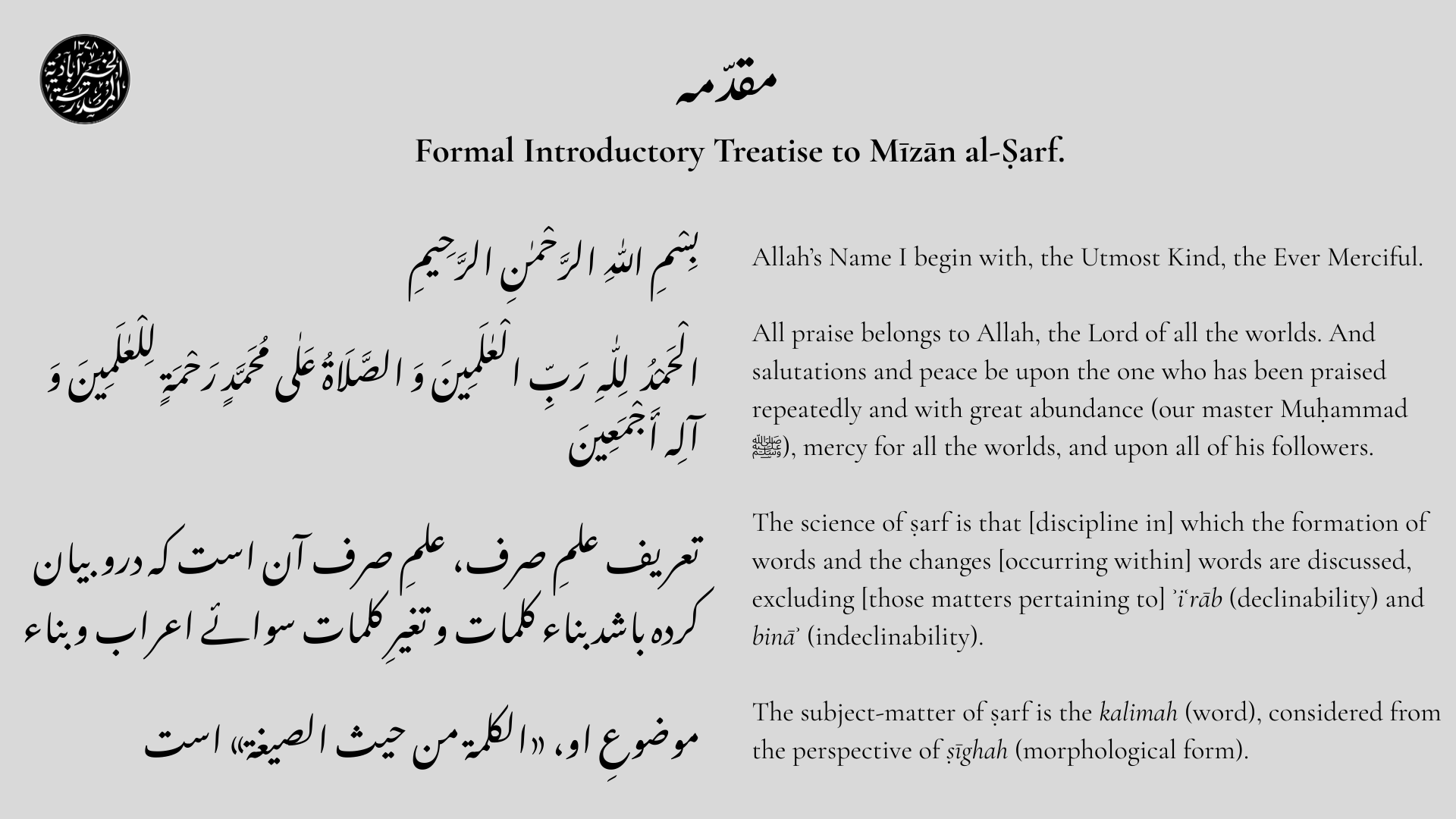
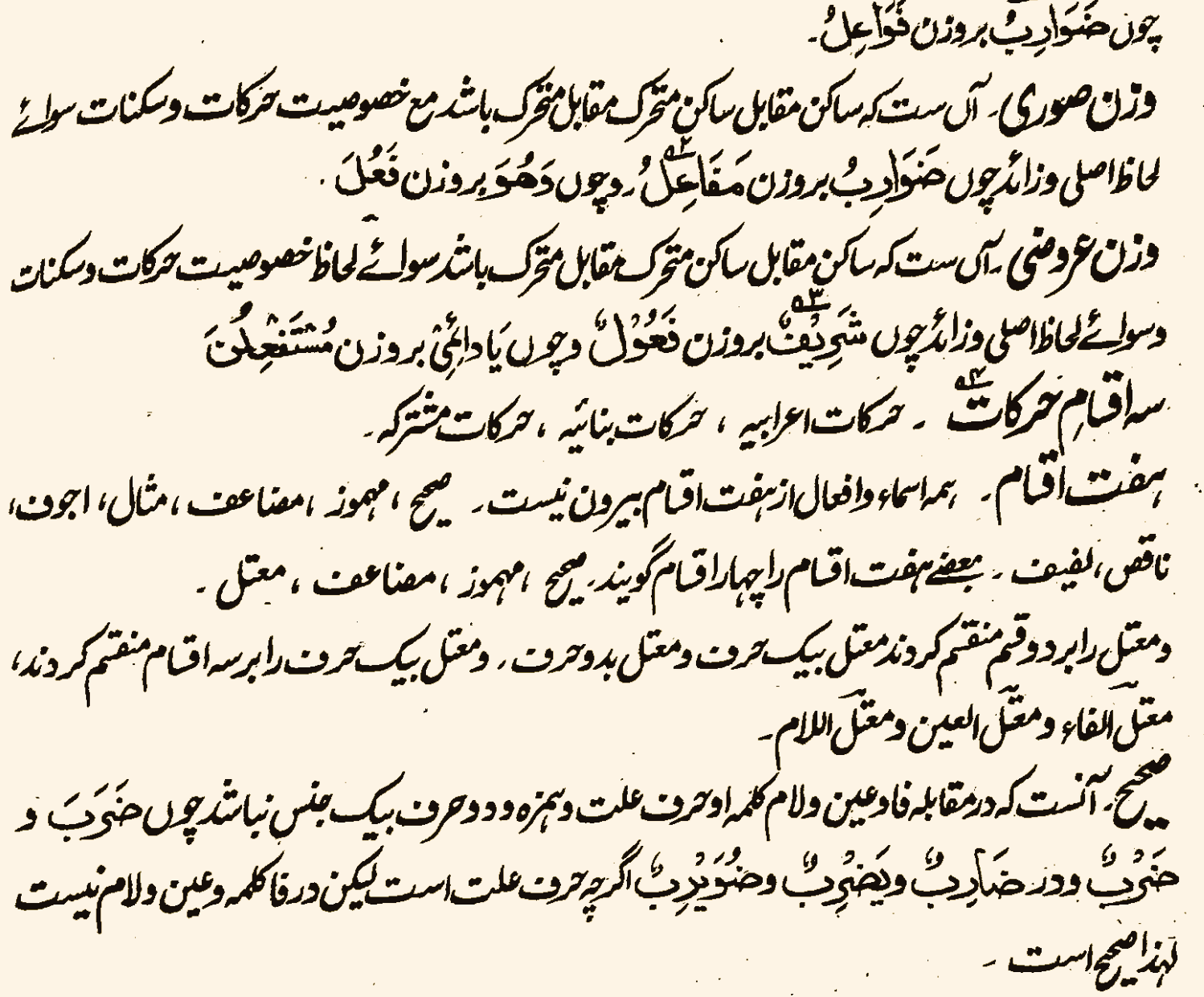
This Muqaddimah functions as a synoptic introduction to the science of morphology, establishing its core concepts before detailed study begins.
This programme is a guided study of the Muqaddimah through a traditional scholarly commentary, comprising fourteen hours of teaching across four sessions.
Short Excerpts from the Sessions
Who This Course Is For
This is not a casual introduction to Arabic.
This programme is designed for serious students of Arabic.
It is suitable for:
Beginners seeking a strong and structured foundation in classical Arabic.
Students with prior exposure who wish to repair conceptual gaps and enter the tradition properly.
Those preparing for long-term study within a formal late-classical curriculum.
No prior knowledge of Arabic or Persian is required. Translations of the text will be provided.
Students are expected, however, to be able to read Arabic script with tashkīl (vowel markings), and to approach their studies with discipline and commitment.
What You Will Gain
By the end of these four sessions, you will not see Arabic as memorisation — but as a structured science entered through defined gateways.
You will gain:
A clear conceptual map of Arabic morphology (ṣarf), understood as the formal gateway into classical Arabic.
A structured understanding of how Arabic developed as a science, including its early formation, major scholars, and principal schools.
The ability to classify and analyse expressions with confidence before entering detailed morphological or syntactic study.
Exposure to traditional methods of disciplined learning that strengthen study beyond Arabic itself.
Direct preparation for year-long study of Arabic through the foundational works of the Farangī Maḥall and Dars-i Niẓāmī traditions in ṣarf and naḥw.

Reflections from Our Students
“Studying texts authored by scholars immersed in the classical tradition is profoundly transformative. They do not merely teach grammatical rules; they transmit a living intellectual heritage.”
Salman, South Asia
"Session 1 exceeded my expectations. The clarity of the instructor about his objective — to provide a clear pathway to Classical Arabic for non-native speakers — was refreshing. I thought I may have felt out of place not having any familiarity with Persian or Urdu, but this was far from the case.”
Donnel, Student
“I'm in my early twenties and for a few years now, I’ve tried to learn Arabic grammar online. However, the way in which Mawlana Mubashir Iqbal taught us Nahw-i-Mir and Risala-i-Kubra by Mir Sayyid Sharif al-Jurjani according to the Khairabadi methodology was informative, effective and revolutionary for me.”
Sarmad Bajwa, Germany
How the Programme Unfolds
Across four structured sessions, students are guided from histrorical contexts & foundational concepts to a complete conceptual map of Arabic morphology — and shown how it opens directly into the study of classical Arabic Studies.
Session Outline
-
A foundational orientation to Arabic as a structured science, with ṣarf as its formal gateway.
1) An introduction to the Arabic language with ṣarf as its gateway, including:
its waḍʿ (conceptual designation)
its historical development
its major scholars
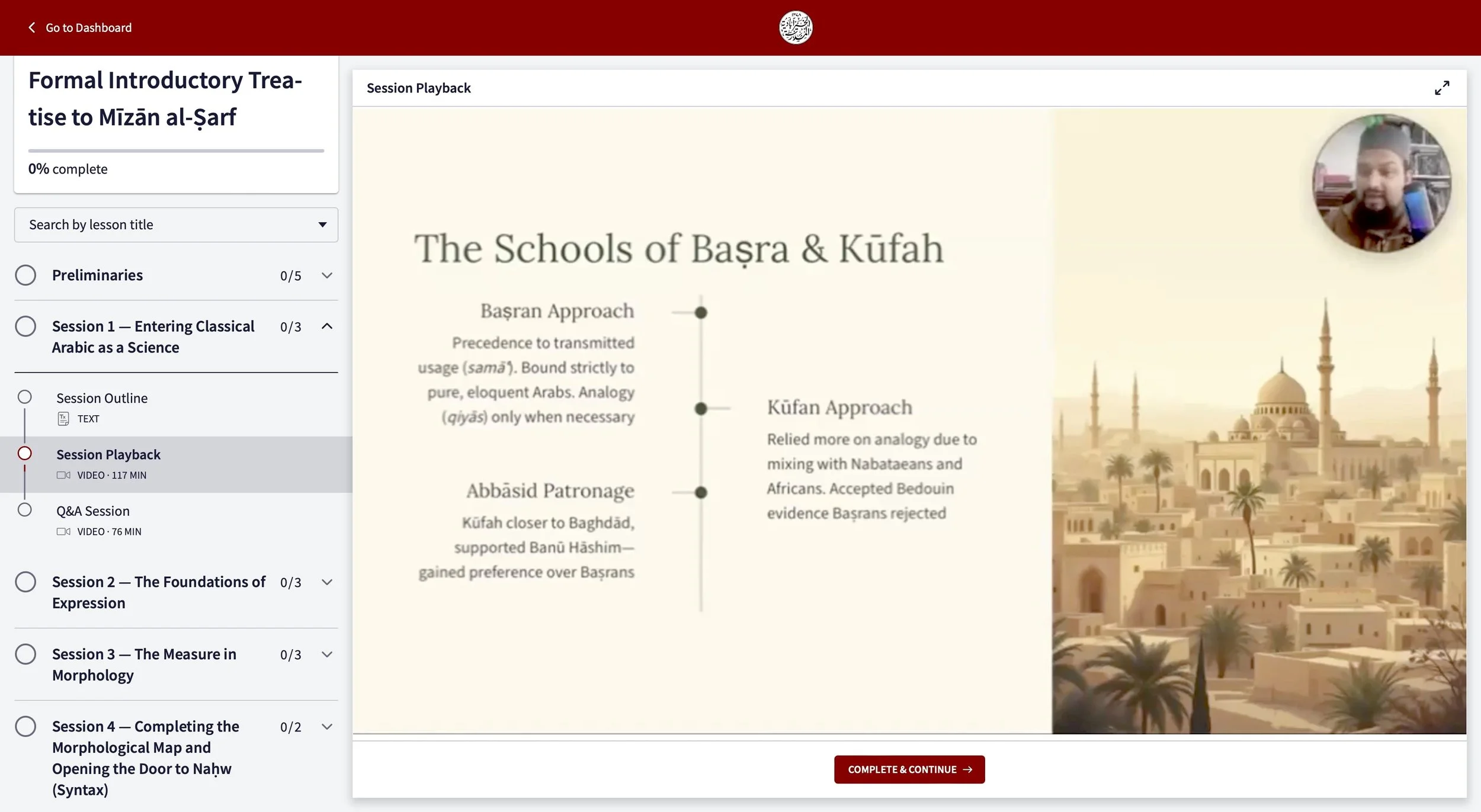
the methodological distinctions between the Baṣran and Kūfan schools
2) An introduction to the teaching of Arabic within the late-classical madrasa curriculum, with particular attention to the Farangī Maḥall, including its objectives and pedagogical ordering.
3) Reference to instructional guidance transmitted within the Farangī Maḥall tradition, such as the principles articulated by Mullā ʿAbd al-Bārī Farangī Maḥallī.
4) The positioning of Mīzān al-Ṣarf within late-classical curricula as the formal entry point into the science of ṣarf.
5) A discussion of the author of Mīzān al-Ṣarf.
6) The Muqaddimah transmitted with Mīzān al-Ṣarf as a pedagogical introduction and synoptic overview of the science of ṣarf, irrespective of strict authorship attribution.
7) Why any serious curriculum in ṣarf requires an introductory grounding in terminology.
8) If time permits:
the khuṭbah of the Muqaddimah
the definition, subject-matter, and purpose of Arabic morphology
By the End of This Session:
Arabic is no longer perceived as a language to memorise, but as a structured science entered through clearly defined gateways.
-
A structured introduction to how Arabic expressions are classified before formal rules are applied.
Text Focus:
1) Lafẓ (utterance / phonetic expression):
lafẓ muhmal → unassigned utterance
lafẓ mustaʿmal → assigned utterance
mufrad → simple expression
murakkab → composite expression
2) Kalimah (word) and its three divisions:
Ism → noun
Fiʿl → verb
Ḥarf → particle
3) Nouns:
Maṣdar → source noun
Jāmid → underived noun
Mushtaq → derived noun
4) Verbs:
Māḍī → past tense
Muḍāriʿ → imperfect (present–future) tense
Amr → imperative
5) Particles:
Ḥurūf al-tahajjī → alphabetic letters
Ḥurūf al-mabānī → structural letters
Ḥurūf al-maʿānī → meaning-bearing particles
By the End of This Session:
The student possesses the conceptual alphabet of Arabic grammar, enabling meaningful classification and analysis before formal morphological or syntactic rules are introduced.
-
An introduction to the morphological scale (mīzān) and how Arabic words are generated through patterned structure.
Text Focus:
1) An explanation of what the Mīzān (morphological scale / template) represents and how it functions within the science of ṣarf.
2) Root structures:
Mujarrad → basic (unaugmented) roots
Mazīd fīh → augmented forms
3) Root lengths:
Thulāthī → triliteral
Rubāʿī → quadriliteral
Khumāsī → quinqueliteral
4) Types of wazan (patterns):
Wazan ṣarfī → morphological pattern
Wazan ṣūrī → formal pattern
Wazan ʿurūḍī → prosodic pattern
5) Vowel classifications:
Ḥarakāt iʿrābiyyah → inflectional vowels
Ḥarakāt bināʾiyyah → fixed vowels
Ḥarakāt mushtarakah → shared vowels
6) Opening of the seven morphological classes (haft aqṣām):
Ṣaḥīḥ → sound forms
Maḥmūz → hamzated forms
Muḍāʿaf → doubled forms
By the End of This Session:
Arabic morphology is no longer encountered as just a list of forms to memorise, but understood as a coherent generative mechanism governed by structure and pattern.
-
Completion of the core morphological classes and the opening of the door into naḥw (syntax).
Text Focus:
1) Completion of the seven morphological classes (haft aqṣām):
Muʿtall → weak forms
Ḥurūf al-ʿillah → weak letters (wāw, yāʾ, alif)
Mithāl → initial weak
Ajwaf → hollow
Nāqiṣ → final weak
2) Lafīf forms:
Maqrūn → combined weak
Mafrūq → separated weak
3) Clarification of what Mīzān al-Ṣarf will later expand upon in tafṣīl (detailed study).
Introduction to naḥw (syntax):
its definition
its subject-matter
its purpose
4) Applied illustration (e.g. through the basmalah), demonstrating:
ṣarf and naḥw functioning together within a single textual unit
Roadmap for continued training in classical Arabic within the late-classical curriculum.
By the End of This Session:
The student will have crossed the first real gateway into classical Arabic, possessing a complete conceptual map of ṣarf and a clear understanding of how it opens directly into the study of naḥw.
-
A taqrīr is a structured articulation of passages from a text in any science, intended to establish its principles firmly in the mind through clarity, organisation, and sound understanding.
In this course, students who wish to engage more deeply will be invited to complete an applied taqrīr analysing a short, unseen passage drawn from within the Farangī Maḥall corpus—applying the principles of ṣarf studied during the course.
This reflects the classical madrasa tradition, where progress was marked not by passive attendance, but by the ability to articulate and apply knowledge.
Mīzān al-Ṣarf and its Muqaddimah in the
Dars-i Niẓāmī
Mīzān al-Ṣarf traditionally formed the first formal text taught in the late-classical curriculum of the Farangī Maḥall, known more broadly as the classical Dars-i Niẓāmī.
Through the scholarly efforts of Khairābādī scholars, this curriculum spread widely and came to shape Arabic instruction across much of South Asia.
In the study of morphology (ṣarf), Mīzān al-Ṣarf was typically followed by works such as Munshaʿib, Panj-Ganj, Zubdah, and Ṣarf Mīr, in it’s early stage.
-
In later curricular developments, the incorporation of ʿIlm al-Ṣīghah came to encompass the material of these texts and more.
Nevertheless, in order to preserve tadarruj (pedagogical gradation) and avoid overwhelming students at the outset, the sequence remains: Mīzān al-Ṣarf, followed by Munshaʿib, and only thereafter ʿIlm al-Ṣīghah.
This ordering allows students to mature gradually in their studies, complete works within a reasonable time-frame, build confidence, and progress with clarity.
Students trained in this manner may later return to texts such as Panj-Ganj, Zubdah, and Ṣarf Mīr for revision and engagement with the turāth.
Following these foundational works, students would proceed to more advanced texts in morphology, such as Fuṣūl-i Akbarī and al-Shāfiyyah, alongside a robust syllabus in naḥw.
The Muqaddimah transmitted with Mīzān al-Ṣarf serves as an exceptional formal gateway—not only into Mīzān al-Ṣarf itself, but into the science of ṣarf as a whole.
While the Muqaddimah may not have been authored by the same scholar as Mīzān al-Ṣarf, it is nonetheless a thoroughly classical composition.
This Muqaddimah functions as a muqaddimat al-ʿilm—a conceptual introduction to the science—and it is likely due to its strength and utility that it became attached to Mīzān al-Ṣarf and was eventually regarded as part of a single instructional unit.
Although the Muqaddimah was originally composed in Persian, an accurate English translation will be provided to all students enroled in this course.
About the Instructor
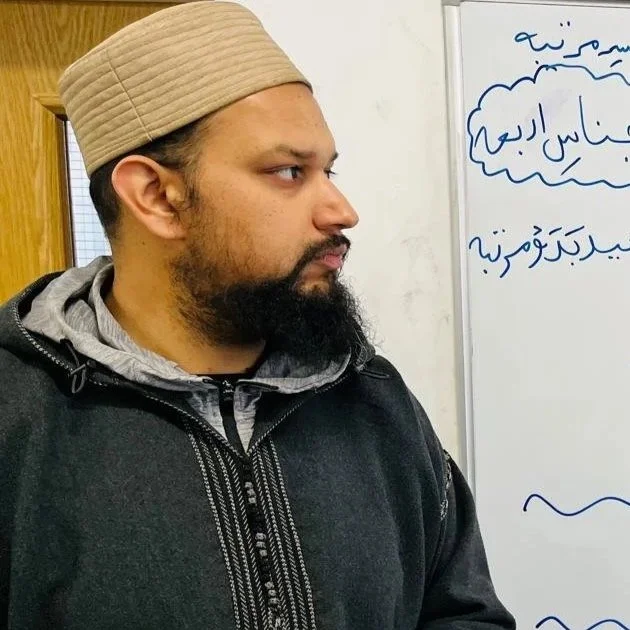
Shaykh Muhammad Mubashir Iqbal
Our Founder
Shaykh Muhammad Mubashir Iqbal teaches within the Khairābādī pedagogical tradition, with a focus these days on structured entry into the classical sciences. His teaching emphasises the pedagogical methods passed down within this tradition alongside faithful transmission of the late-classical curriculum.
He began his studies at the age of eleven at Jamʿia al-Karam, where he spent a decade before also teaching Arabic in his final years. He went on to study Persian texts and advanced Dars-i Niẓāmī works at Dārul Qurrāʾ and Islamic Research Centre in England, and later engaged with scholars of diverse backgrounds in Istanbul, including scholars of Shām.
He pursued Ḥadīth studies at Dār al-ʿUlūm Muḥammadiyyah Ghawthiyyah in Bhera, Pakistan, and completed the final books of the Dars-i Niẓāmī curriculum at Jamʿia Qādiriyyah in KPK, including al-Hidāyah, Mīr Zāhid Umūr al-ʿĀmmah, Mīr Quṭbī, Shams-i Bāzigah, and commentaries on Sullam al-ʿUlūm.
His sanad in the rational sciences traces back to Imām Fazl-i Ḥaq Khairābādī, Mullā Niẓām al-Dīn Sihālwī, Mīr Sayyid Jurjānī, ʿAllāmah Mubārak Shāh, Qāḍī ʿAḍud al-Dīn al-Ījī, Imām Abū Ḥāmid al-Ghazālī, and Imām Abū al-Ḥasan al-Ashʿarī, may Allāh have mercy upon them all.
With extensive teaching experience, he excels in the classical Khairābādī/Farangī Maḥallī curriculum. He has disseminated his knowledge in various seminaries across England, including Greengate Islamic College, Cambridge Muslim College, and Manchester Muslim College, leaving an indelible mark on his students.
Course Details & Enrolment
Overview
Format: Full session recordings, supplementary notes, and an English translation of the text
Telegram: Student group with direct access to the instructor
Access: Eleven months from date of enrolment
Materials: Recordings and supplementary notes
Note: Your enrollment fee will be credited in full toward the Year 1 Arabic programme when it launches
Enrollment
£49 — One-Time Enrollment
Enroll at any time. Immediate access to all sessions.
You will be redirected to our secure course portal to complete your enrollment.
Secure online payment • Immediate confirmation • Instant access to course portal