
The Traditional Curriculum
& the Question of Comprehension
A common suggestion is that seminary students lack sufficient comprehension practice and would benefit from reading widely in English on the subjects they study, in order to contextualise their knowledge within a modern setting.
This observation rests on an assumption worth examining: that comprehension is an activity external to the traditional texts themselves; something that must be imported from outside the curriculum rather than cultivated within it.
The assumption holds where a curriculum is left significantly incomplete. If, for example, a student of manṭiq never advances beyond introductory primers, and the higher-level works, such as the commentaries on Sullam al-ʿUlūm by Mullā Ḥasan or Qāḍī Mubārak, or works like Sharḥ al-ʿAqāʾid al-Jalāliyyah, are omitted entirely, then one could reasonably say that only the mabādiʾāt (foundational rules) have been covered, and that less occasion has arisen for genuine application of logical skill. The objection, in such a case, may have a valid object.
However, where the curriculum is traversed in full, where a student has engaged with these advanced works, navigated their layered argumentation, and struggled through the demands they place on the reader, the suggestion that he has not practised comprehension or applied his skills becomes difficult to sustain. These texts are the comprehension exercise. Their study is the applied practice. To claim otherwise would require one to demonstrate what, precisely, these works fail to demand of the student intellectually; a demonstration that is rarely forthcoming.
It should also be noted that logic, in the classical tradition, is not confined to texts formally designated as works of manṭiq. It is the operative instrument across the sciences, kalām, uṣūl, balāghah and others, such that a student who has traversed the curriculum has encountered its application far beyond the logic texts themselves.
As for reading in English on the subject: this depends entirely on what end one has in view. If a student's aim is to access the late-classical tradition, and through it, the earlier layers that precede it, and to engage within its broader intellectual discourse, then the traditional curriculum, studied properly and completely, principally serves that end.
If, however, the aim is to engage with the same subject as it appears in modern academic or English-language literature, then naturally one could supplement with works suited to that purpose. Conflating these two aims leads to misplaced criticism: faulting a curriculum on the basis of what is not its primary objective.
The late-classical curricula, after all, aim to cultivate in the student a malakah, a deeply rooted intellectual competence, such that he can access the tradition with fluency and ease. And it follows naturally that one who possesses such a malakah would find little difficulty engaging with the subject from a contemporary academic standpoint, should he need to do so.
None of this is to say that suitable supplementary reading or comprehension exercises are without value. We ourselves provide structured assessment questions alongside our primer texts, as well as supplementary reading beyond the core curriculum works, within our Khairabadī-Niẓāmī syllabus. The point is simply one of precision: the objection, when examined, applies to incomplete engagement with the tradition, not to the tradition itself. One suspects that those who have traversed the tradition would find less reason to raise it.
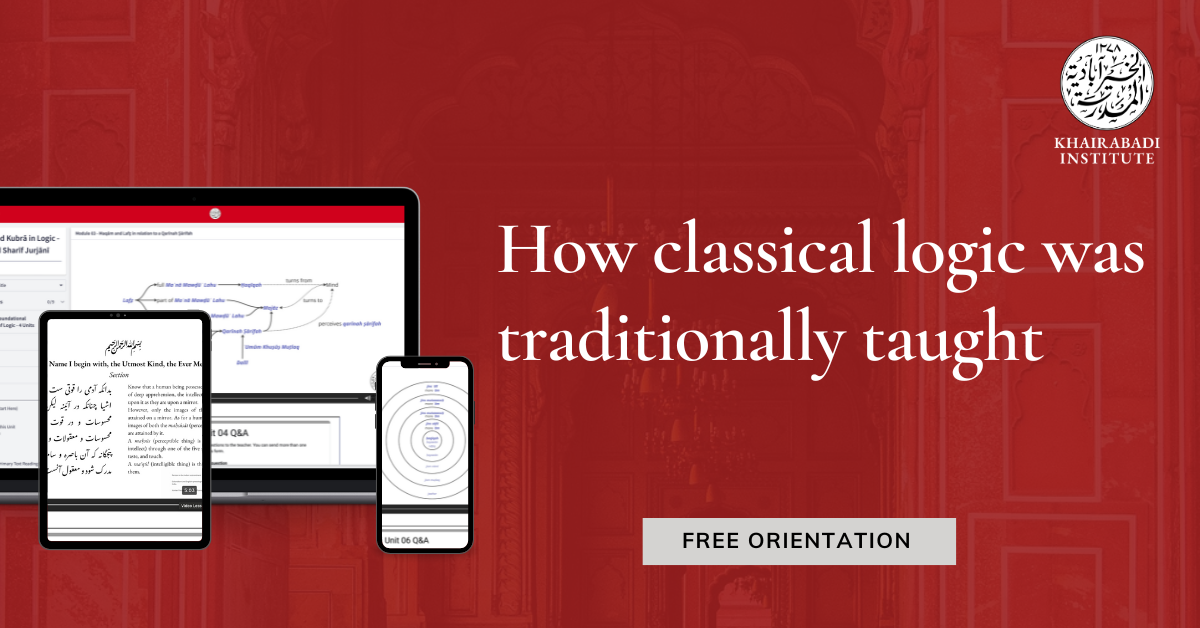
Access the Free Logic Orientation
A guided introduction to classical logic as taught in the Farangī Maḥall tradition.
