Entering the Language of the Holy Qurʾān
Through the Gateway of the Classical Arabic Tradition
Free Access to a Complete Preview Session
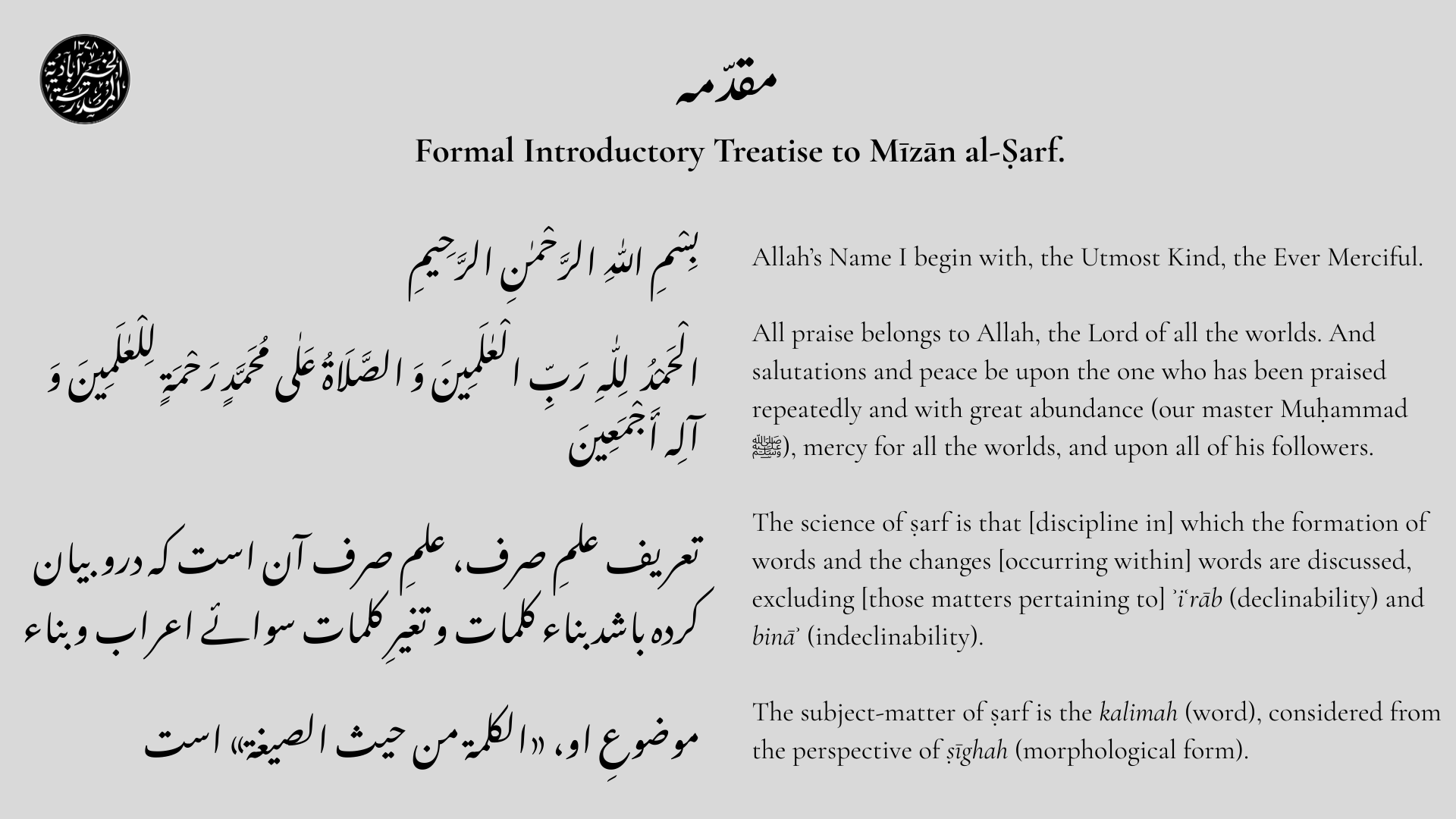
A guided preview from the Muqaddimah to Mīzān al-Ṣarf — the foundational entry text of the Farangī Maḥall and Dars-i Niẓāmī curriculum.
Part of the Classical Arabic Programme (£49 full course)
Why This Session Matters
Many students attempt to learn Arabic through scattered grammar rules.
In the classical scholarly tradition, however, Arabic was entered through a structured sequence of sciences.
Because the study of syntax (naḥw) depends upon morphology (ṣarf), students first approached the science through the Muqaddimah transmitted with Mīzān al-Ṣarf — a conceptual introduction establishing the foundations of Arabic.
What You Will Learn in the Free Session
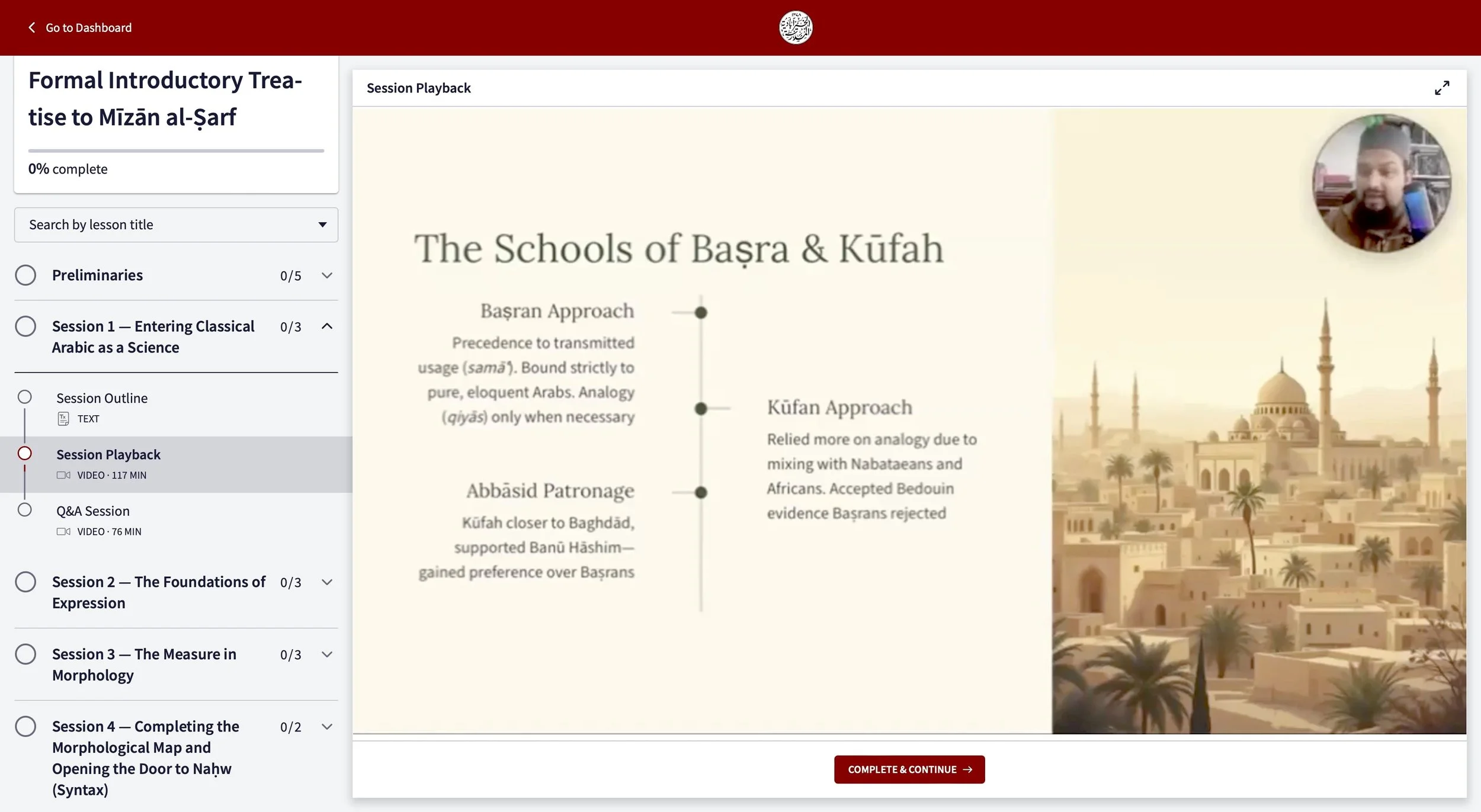
In this session, you are introduced to the foundational classifications of the Arabic language as they appear in the Muqaddimah to Mīzān al-Ṣarf.
Topics include:
• Lafẓ (utterance): the distinction between unassigned and assigned expressions, and between simple and composite forms
• Kalimah (word) and its three divisions: ism (noun), fiʿl (verb), ḥarf (particle)
• The subdivisions of nouns: maṣdar, jāmid, and mushtaq
• The subdivisions of verbs: māḍī, muḍāriʿ, and amr
• The subdivisions of particles: ḥurūf al-tahajjī, ḥurūf al-mabānī, and ḥurūf al-maʿānī
• Taught in the Khairābādī style: with points of benefit for both advanced and beginner students, incorporating mantiq within the morphological categories
By the end of this session, you possess the conceptual alphabet of Arabic grammar, enabling meaningful classification and analysis before formal morphological or syntactic rules are introduced.
The Classical Pathway into Arabic
The classical curriculum followed a clear intellectual progression:
Muqaddimah
↓
Mīzān al-Ṣarf
↓
Ṣarf —Morphology
↓
Naḥw —Syntax
↓
Access to Qurʾānic Arabic and the wider scholarly tradition
This free session gives you a direct experience of how the classical tradition approached Arabic from the ground up.
Who is this Session For?
This session is suitable for:
• Beginners seeking a structured foundation in Arabic
• Students who have previously studied Arabic but feel conceptual gaps remain
• Anyone wishing to understand how Arabic was traditionally taught within the madrasa curriculum
Students only need to be able to read Arabic script with vowel markings.
No prior study of Arabic or Persian is required.

Reflections from Our Students
I'm in my early twenties and for a few years now, I’ve tried to learn Arabic grammar online. However, the way in which Mawlana Mubashir Iqbal taught us Nahw-i-Mir and Risala-i-Kubra by Mir Sayyid Sharif al-Jurjani according to the Khairabadi methodology was informative, effective and revolutionary for me.
— Sarmad, Germany
About the Instructor
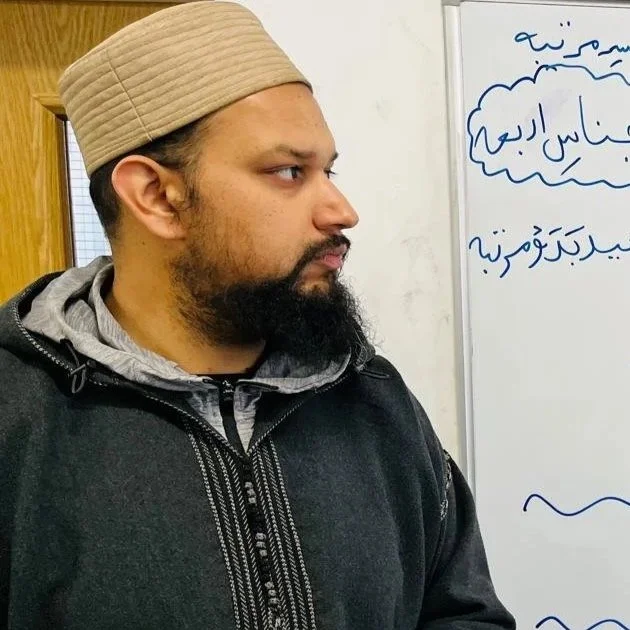
Shaykh Muhammad Mubashir Iqbal
Our Founder
Shaykh Muhammad Mubashir Iqbal teaches within the Khairābādī pedagogical tradition, with a focus these days on structured entry into the classical sciences. His teaching emphasises the pedagogical methods passed down within this tradition alongside faithful transmission of the late-classical curriculum.
His sanad in the rational sciences traces back to Imām Fazl-i Ḥaq Khairābādī, Mullā Niẓām al-Dīn Sihālwī, Mīr Sayyid Jurjānī, ʿAllāmah Mubārak Shāh, Qāḍī ʿAḍud al-Dīn al-Ījī, Imām Abū Ḥāmid al-Ghazālī, and Imām Abū al-Ḥasan al-Ashʿarī, may Allāh have mercy upon them all.